
Writing at the turn of the 20th century, Rudolph Virchow, the venerated medical researcher and father of cellular pathology declared that “Medicine is a social science and politics is nothing else but medicine on a large scale”. He went on to elaborate that “Medicine as a social science, as the science of human beings, has the obligation to point out problems and to attempt their theoretical solution”. Yet modern medicine generally, and medical journals in particular have preferred to project the image of being strictly scientific and ‘above politics’. This was particularly true of the South African Medical Journal (SAMJ) especially during the apartheid years, but certainly also after the advent of the 1994 democratic dispensation. That is, until Chris Bateman arrived.
In 2000 the SAMJ resolved to establish a new column titled ‘Izindaba’, a Zulu word for news, and to recruit a journalist onto its staff to write stories of general interest relating to health and medical developments in the country. The Journal identified one Chris Bateman, whose reputation as an experienced and accomplished journalist in the newspaper world preceded him, and he was duly appointed. I was then editor of the SAMJ and, as a Zulu speaker myself, I was mildly intrigued and somewhat sceptical when I was told that Chris – an English-speaking white South African – spoke Zulu. I was therefore blown away to discover, upon meeting him in person, that Chris spoke the language like a native Zulu speaker as if, as the Zulu saying goes, ‘IsiZulu wasincel’ ebeleni – he suckled Zulu from (his mother’s) breast’.
Chris proceeded gradually to develop the Izindaba column well beyond what we had envisaged when we conceived it. It became not just a column about trite and ‘feel good’ stories relating to health and medical events and people, but a place for serious investigative reporting. True to Virchow’s doctrine, Chris reported not just what happened, but why it happened, and set out the consequences for the public health from the point of view of an advocate for fairness and integrity in the conduct of public service. His investigations included in-depth interviews with significant players as well as exhaustive document-based research. South Africa was facing daunting challenges in the delivery of health services in the face of a formidable disease burden including HIV, and Chris did not shrink from investigating and holding to account those responsible for failures or corrupt practices in the delivery of health care.
Chris’s column received wide attention from a diverse readership both nationally and overseas. His work was frequently cited by other writers and researchers. He was a multiple journalism award winner, including for ‘The Best Trade Publication’. In one citation for an award for an article he wrote on mental health underfunding, it was noted that ‘in presenting analysis together with a well-chosen personal narrative, Bateman made a persuasive and indispensable case for proper care’.
Following his recent brush with cancer, Chris has written a series of articles describing his personal experiences with the whole process of cancer diagnosis and treatment, and those who have read some or all of the writings will have been struck by his ability to present a highly personal story of misfortune with an appropriate degree of detachment, and a sense of calm and reassurance.
As we would say in Zulu: ‘UChris unobuntu – Chris has ubuntu’
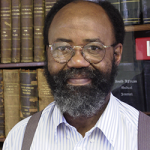
Dan J Ncayiyana
Emeritus editor, South African Medical Journal
Chris Bateman is a colleague who I hold in high regard.
We worked closely together for about 11 years in the medical publishing group, HMPG, which produced the South African Medical Journal (SAMJ), South Africa’s premier medical journal, and a dozen specialist medical journals. When I joined the organization as deputy editor of the SAMJ and later managing editor of the group, Chris was already a member of the news team. He had come from a newspaper career where he had distinguished himself for fearless reporting of dangerous political events at the time.
In short time Chris moved from being a reporter to columnist and then as the sole person as news editor to fill the medico/political/health section of the SAMJ called Izindaba. Under his authorship this became a popular and authoritative part of the journal that was quoted in academic circles and also the reason for his recognition as a prize winning writer in his new field. He also contributed to other journals in the stable.
Chris has the personality and non-threatening style, together with his proficiency in languages, including isiZulu that enabled him to connect and communicate with individuals at all levels and walks of life and to make stories live. He has a nose for important events and the capacity to relate these in an informative and enjoyable manner. As a reliable and scholarly colleague who cares deeply for all in society I count it as a privilege to have had Chris as a colleague and friend from whom I learned a great deal.